
The Society for Analytic Philosophy (GAP) and Grazer Philosophische Studien annually grant an Essay Award to students.
Up to three awards are granted. The award-winning essays are published in the Grazer Philosophische Studien. The current calls for submissions are always published here and as GAP announcements.
The current Essay Award 2026
The Prize Question
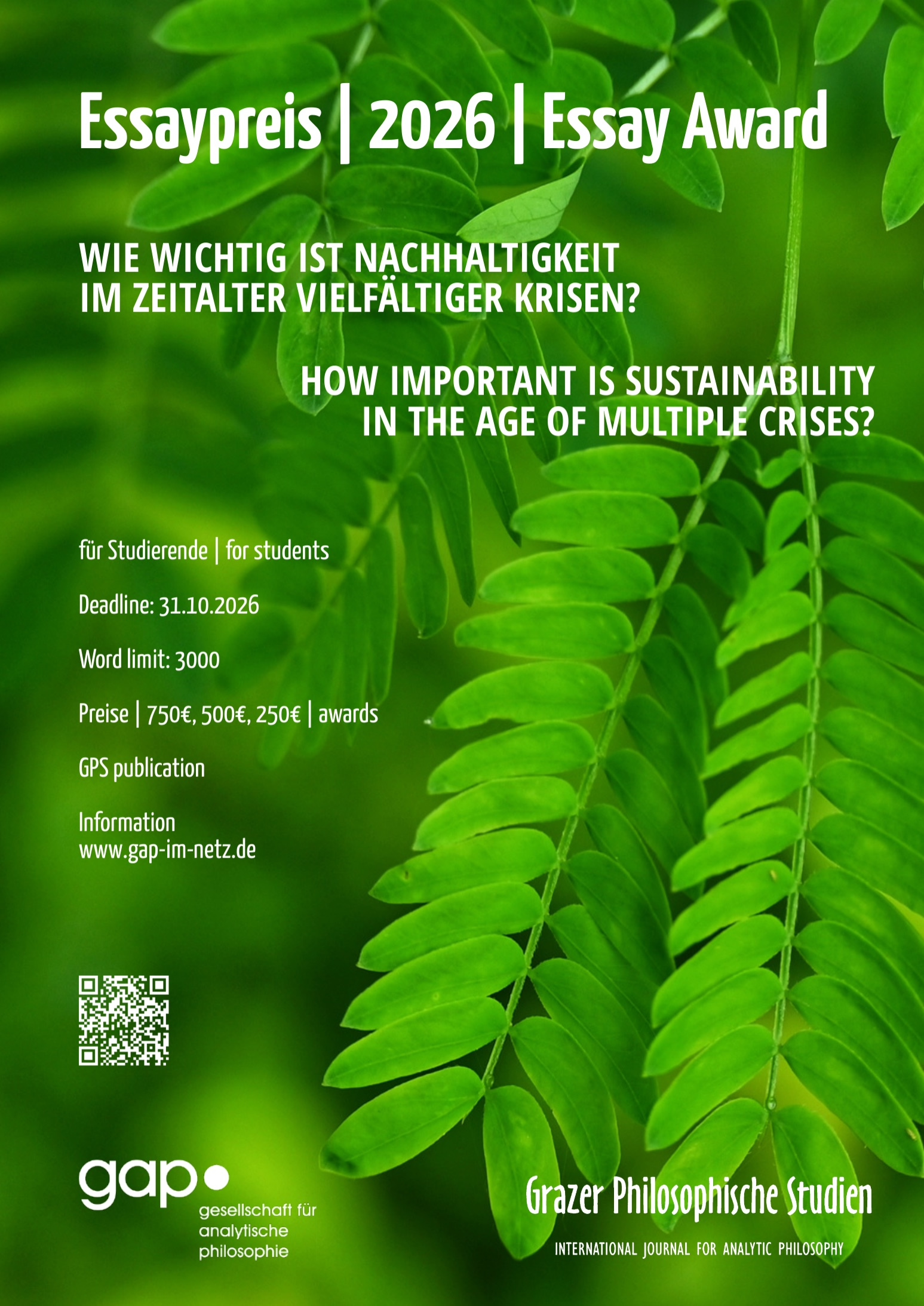
“Wie wichtig ist Nachhaltigkeit im Zeitalter vielfältiger Krisen?”
“How important is sustainability in the age of multiple crises?”
The essay shall address the question but does not need to bear this title. Up to three prizes are awarded: First prize €750, second prize €500, third prize €250 (for unranked awards, the prize money is €500).
The award-winning essays are published in the Grazer Philosophische Studien. They must therefore be suitable for publication in a philosophical academic journal. For this, a scholarly argumentative text is expected that is connected to a debate / research literature. The Grazer Philosophische Studien are an international German- and English-language journal for analytic Philosophy. They have been published since 1975.
Co-authorship is possible; however, all authors must meet the conditions of participation and share the award. Multiple submissions are not permitted.
The deadline for submissions is 31 October, 2026. Further information on the conditions of participation and on submission can be found here:
Eligible for the Essay Award are all persons who meet the following conditions by the deadline.
- You are currently enrolled in a Bachelor’s or Master’s degree program or have completed such a degree program no more than one year ago.
- The above-mentioned course of study is a degree program in Philosophy or an interdisciplinary degree program that demonstrably provides for at least 40 ECTS in Philosophy.
- You are a GAP member or the aforementioned degree programme takes or took place at a university where German is an official language of instruction.
- You are not enrolled at all or have been enrolled for a maximum of one year in a philosophical doctoral program and have not completed a doctorate in philosophy.
To be submitted by 31 October of the relevant year is an essay on the stated topic in German or English as a PDF document and together with a certificate of enrollment or degree certificate (in electronic form). The essays may not exceed 3,000 words including title and footnotes, but excluding the list of cited literature. Footnotes should be used sparingly and references, with author, year and page number, should be integrated into the text. All books and articles explicitly referred to in the essay should be listed at the end in author alphabet.
Each submission must also include a separate cover sheet stating, in addition to the word count excluding the references, the following information: name, degree programme, semester, university, postal address, email address, and date of submission. The cover sheet must also include a signed confirmation that the conditions of participation, as stated above, are met. The essay itself must be anonymised; it must not contain any indication of the author(s) on any page or in the metadata.
Please address your submissions to info@gap.ngo.
Preview
The prize question for the next Essay Award will be announced in early 2027. Nevertheless, you can already find a preview of the upcoming prize question here:
“Können Meinungen anderen unrecht tun?”
“Can beliefs wrong others?”
Through this preview we wish to enable instructors to incorporate this topic into the planning of their courses, and to enable students to approach instructors about this option. The call for submissions is planned for early 2027 under analogous conditions, so that students can be well prepared for their own submissions for the Essay Award 2027 through suitable classes in, for example, the winter semester 2026/27 or the summer semester 2027.
Previously Awarded Papers
First Prize: Emilia Kleo Mertens (Freie Universität Berlin): “Möglichkeitsräume des Handelns und Grenzen der Hoffnung” (Abstract)
Second Prize: –
Third Prize: Severin Rohrer and Jan Stettler (Universities of Vienna and Zurich): “On the Perils of Hope Under Oppression” (Abstract)
Third Prize: Sofus Jonathan Messell (University of Oxford): “How does hope matter for our actions?” (Kurzzusammenfassung)
First Prize: –
Second Prize: Marius Mumbeck (Universität Duisburg-Essen): “Is there a domain of linguistic competence AI cannot grasp?” (Abstract)
Third Prize: Julian Braunwarth (Georg-August-Universität Göttingen): “Was eine KI niemals können wird, wird auch der Mensch niemals können” (Abstract)
First Prize: Nils Neuhaus (Technische Universität Berlin): “Die Herausforderung historisch kontingenter Begriffe für die analytische Philosophie am Beispiel der Menschenwürde” (Abstract)
First Prize: Jakob Lohmar (Universität zu Köln): “Future Selves and Present Moral Philosophers” (Abstract)
First Prize: Konstantin Weber (Friedrich-Alexander-Universität Erlangen-Nürnberg): „Accepting Inconsistency“ (Abstract)
First Prize: Jonas Pöld (Universität Münster): “Lügen und Redefreiheit” (Abstract)
First Prize: –
Second Prize: Sebastian Schmidt (Friedrich Alexander University Erlangen-Nuremberg): “Können wir uns entscheiden, etwas zu glauben? Zur Möglichkeit und Unmöglichkeit eines doxastischen Willens”
Second Prize: Simon Walgenbach (University of Duisburg-Essen): “Können wir uns entscheiden, etwas zu glauben?”
First Prize: Dorothee Bleisch: “Die Moralpille – über Risiken und Nebenwirkungen denken Sie eigenständig nach und fragen Ihren Philosophen oder Ihre Philosophin”
Second Prize: Philip Fox: “Agency and the pill that makes us moral”
Third Prize: David Christian Heering: “Breaking Good: Is there a patent recipe for cooking up the moral pill?”
First Prize: Tammo Lossau: “Was heißt ‚sich vorstellen, eine andere Person zu sein‘?”
Second Prize: Eva Lucia Backhaus: “Kann ich mir vorstellen, eine andere Person zu sein?”
Third Prize: Viktoria Knoll: “Kann ich mir vorstellen, eine andere Person zu sein?”
First Prize: Salim Hirèche / Sandra Villata: “Eating Animals and the Value of Non-Human Suffering”
Second Prize: Simon Gaus: “Moralischer Vegetarismus: Folgt aus dem Unwert der Tierhaltung ein Verbot des Fleischkonsums?”
Third Prize: Jens Tuider: “Dürfen wir Tiere essen?”
First Prize: –
Second Prize: Amadeus Magrabi: “Can we Trust our Feelings? On the Value of Feelings for Decision-Making”
Third Prize: Stefan Reining: “Do Pain-Accompanying Emotions Mislead Us? – Considerations in the Light of Reactive Dissociation Phenomena”
First Prize: –
Second Prize: Stefan Reining: “Verpflichtungen gegenüber zukünftigen Generationen im Lichte der Goldenen Regel”
First Prize: Max Seeger: “Experimental Philosophy and the Twin Earth Intuition”
Second Prize: Sebastian Köhler: “Thought-experiments, Disagreement and Moral Realism”
Third Prize: Stefan Reining: “Über die vermeintliche Unzulässigkeit physikalisch unmöglicher Fälle in der Debatte um diachrone Personenidentität”
First Prize: –
Second Prize: Stefan Reining: “Über den möglichen Wert der Unwissenheit”
Third Prize: David Ludwig: “Die Sorge um die Wahrheit”
Fourth Prize: Susanne Mantel: “Warum nach Wahrheit suchen?”
First Prize: Lars Dänzer: “A Neglected Argument for Compatibilism”
Second Prize: Anselm Spindler: “Über moralische Verantwortung und alternative Möglichkeiten”
Third Prize: Andreas Maier: “Weeding in the Garden of Forking Paths – Yet Another Look at Alternative Possibilities”